Monday, December 24, 2012

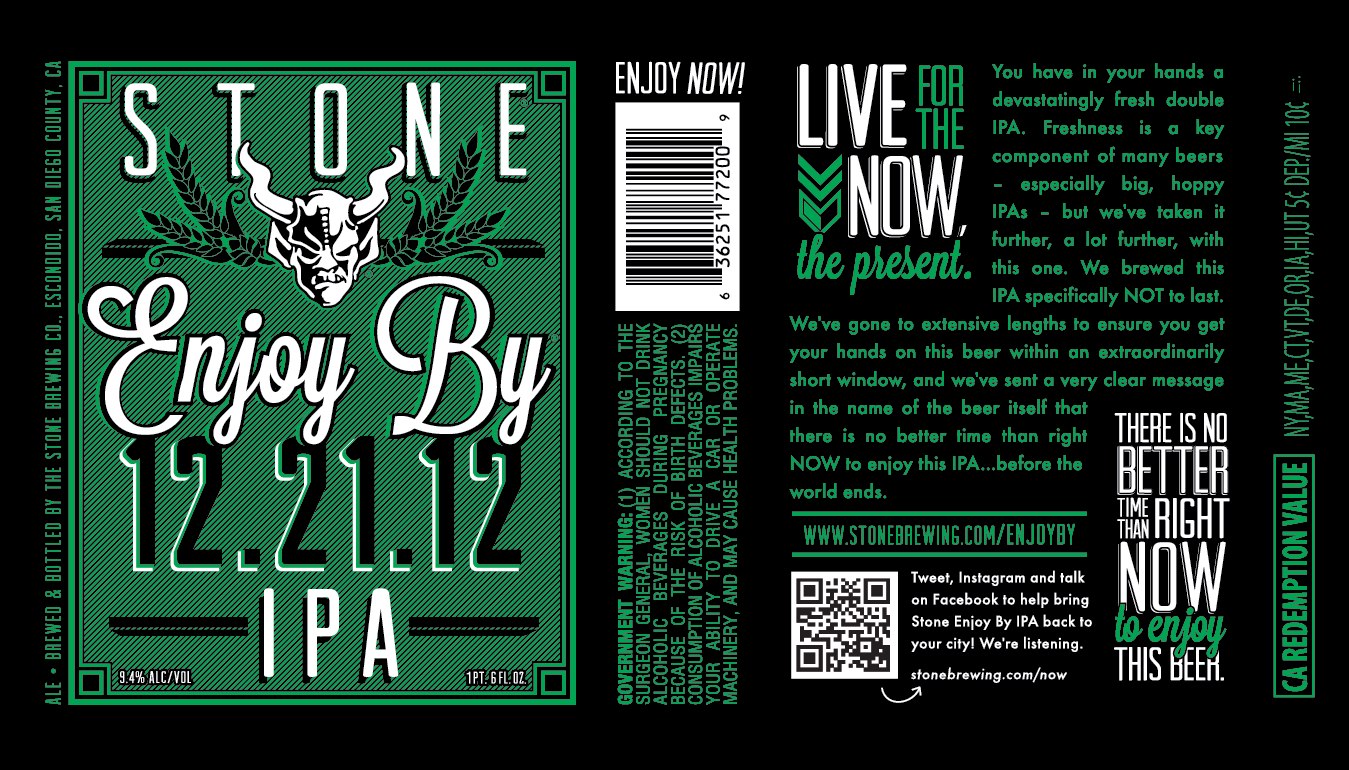
Enjoy By 12-21-12

Tasted Friday night hanging at Jen's parent at their new basement bar. Jen found this bottle at Hy-vee by asking for it as it was hidden behind the counter. We broke it out around 10 pm on 12.21.12.

Appearance: Golden and pristinely bright. A nice frothy white head is well sustained. Lacing is cascaded and wet. A gorgeous appearance.
Aroma: Clean, fresh and very aromatic. Reminiscent of pine, and fresh tropical fruit, specifically melon and zesty orange
Taste: Mango and papaya erupt in a strong citrus and tropical citrus. This dominates the majority of the fore flavor. The middle is nicely balanced by a light fruity complexity. To finish is a faint note of ester and alcohol. Finally the aftertaste holds a brief element of pine, but ever so slight.
Mouthfeel: Minimal carbonation, but the way it is incorporated into the beer adds a different sensation. It seems, how ever so slight, the carbonation stands apart. Light body and very refreshing.
Overall Impression: Yup, everything the bottle says is true. I like the change up from the typical expectation from Stone which is the huge west coast citrus. The melon character definitely was noticeable and well balanced. As fresh as it gets.

Wednesday, December 19, 2012

The Blending of Blue Sunday Sour


We are but a month away from the Blue Sunday release party, so I figured now would be a good time to give a pre-taste of the workings behind this revered sour ale. I will outline some history behind the beer and its name, its general composition, and the systems/techniques I used for blending. Finally I'll explain (in brief) where the New Holland sour program is going.


For those who don't know, I work at New Holland Brewing Company!
I left Great River Brewery in March of 2012 and moved to Holland where I started as a brewer last April. Working full time on the brewhouse and occasionally on the filler for the first 4 months, I had already realized I'd found a pretty great company. Around August, our wood master left and I was then given reign over the Dragon's Milk cellar and the sour beer program. I had little experience working with wood prior, except the few times I filled a Templeton Rye barrel with GRB Farmer Brown, so this was a daunting promotion. Nevertheless, I hit the books and asked questions to anyone I could. Gradually I learned the ins and outs, but still lurking over my head was a Nightmare (I'll get to this later) of a task - Creating 2013's Blue Sunday Sour.
Brewer Jon helping pull beer from barrels

Fast forward to now and it's already in the tank! I sit here reflecting on what a great experience it was and how much I learned. And I'll say, I can't wait for the next one. But right now, and I know you're reading this post to learn how it was done, so let's start at the beginning...

To my knowledge, Blue Sunday is named to commemorate the sale of alcohol in Holland, and to celebrate the access of good beer at home and in pubs and restaurants, seven days a week. To that, this beer represents another year of success for both us and the industry.

We specifically brew a beer called Blue Sunday, but Blue Sunday Sour is a byproduct of not just that beer, but many others that have intentionally been blended to reach a flavor we feel is of adequate quality for our customers. We age it for you, so it's ready to be consumed as soon as you palm it off the shelves.

185 Sour barrels!
In the first couple months prior I was still on the Brewhouse as we trained a new Brewer. Two to three days a week I worked Dragon's Milk. Finally, once our new brewer, Jon, was fully trained I could finally work full time barrels and begin formulating the blend for Blue Sunday.

One of the biggest difficulties I faced was tasting the sours themselves. Sure I had a beer blog, knew what butyric acid was, and could operate most of the equipment needed to make good commercial beer, but sours? That was a different ball game. Fortunately, my co-workers helped me out by bringing in a vast range of stylistic sours to try and gradually I acquainted myself with what constitutes a sour beer.
Great, the next task was tasting all 130 sour wine barrels and deciphering good from "not ready" (we don't use the term bad - when beer ages and sours it goes through a life cycle of flavors ranging from barnyard to delightfully tart and fruity). This went on for about two weeks, (and) whenever I had time.

Figure 1: Barrel Anatomy
Another issue I faced was accessing the barrels for samples. Typically, one can do this by popping the bung and using a "thief" to taste the beverage. But opening a barrel in this manner and sticking a hollow rod into the liquid risks exposing the beer to oxygen. The oxygen becomes a source of metabolic energy for a group of bacteria called the Acetobacter. While present in many of these sour barrels, they are kept at bay by other bacteria such as Pediococcus and Lacotobacillus and several varieties of a yeast in the genus Brettanomyces.
An alternative is to drill a hole in the head of the barrel, a couple inches above the chime. (see Figure 1: Barrel Anatomy) and plug it with a stainless steel nail (acidity of the beer would deteriorate the nail rapidly if it is anything else).
I could finally get to tasting after I had gotten all 130 barrels drilled and nailed and re-arranged for ease of access.
The next thing I needed to do was develop a plan of attacking these barrels. Fortunately, I had just read a helpful article on Lauren Salazar an her methods and techniques for blending sour beer (Embrace the Funk). I ended up utilizing her symbols for describing the status of each barrel. As Lauren describes:

"I have what I call “Users, Blenders or Waiters”. The “Users” are ready to make beer, the “Blenders” are if you need to make more beer and “Waiters” are just that…they need some time so we wait. So my quality thing is I put a Smiley Face, Sideways Face or Frowny Face. So you might see a “User” with a smiley face and a “User” sideways face…the smiley face one gets used first. "  (Embrace the Funk)
This worked perfectly for me.
Method:
I started in September tasting each barrel, some two or three times. My plan here was to weed out the barrels that were not yet ready (not bad, remember?). This was a relatively easy task. I looked for barrels that still tasted like beer, barrels that perhaps still in their Buttery stage of a pediococcus residence, or perhaps just an unbalanced flavor. These barrels are then set aside to continue until perhaps next year, if and when they are ready.
Tasting notes
The next phase was a bit more challenging. This is where tasting other commercial beers and recognizing desirable flavors by style comes in. I knew I wanted something tart, somewhat reminiscent of 2010 and 2012, yet not as sour as The La Folie. I wanted notes of stone fruit, like plums, but a touch of grapes and fig as well. Similarly, I thought it important to let the wood stand out in the finish. So I went about making combinations. I would prowl the field of barrels building a blend that maintained these characteristics. If an addition took me in the wrong direction, I would have to start over.
In the final days I had composed a blend comprised mostly of Blue Sunday, but along with several other varieties of beer.
This near final blend exhibited just about everything noted above, but was missing something. I brought it down to a vote, so, blending three exact pitchers full, I left one untouched for a control, and the two others each had a one barrel addition to reach an acceptable product.
Votes were tallied and our blend was decided. The hard work was over, but my nerves had not yet subsided. I had yet to ACTUALLY blend these beers, which meant there was no going back after they were in the tank.

Work Station
The next week was the week before thanksgiving and I chose Tuesday as the day to blend. It was a cluster-f**k organizing the barrels, as some that were needed were on the same rack while others were paired with ones I would not use. Sorting and organizing them before and after was another Nightmare (remember?). Nevertheless, everything went smoothly. I blended all the barrels that would constitute a base as well as the barrels that offered more complexity. As the final barrel I had planned on blending went into the tank, I took a sample off the Zwickel. My worst dream had become a reality. That last barrel I had added wasn't filtered, therefore some yeast had settled on the bottom and had begun to develop some un-wanted flavors, of which some had gone into the tank. Tasting the beer, Andrew and I had recognized it as Mercaptan, a byproduct of autolysed (dead) yeast. To the customer, it would be hardly recognizable, but we had just done a taste panel on it and learned to diagnose it in beer. I wanted this blend to be perfect, so this was unacceptable.

To solve this problem, I went back to my tasting notes. I knew I had left a few fantastic barrels behind in case something like this happened. I went through my notes and looked for the barrels that were quite tart, but still had a fruity base to reinforce the complexity. I added one barrel, and found the flavor enhanced along with the tartness, almost completely offsetting the faint Mercaptan flavor. Just to be sure, I added one more.

And I couldn't be happier with the result. Blue Sunday now waits in D5 to be bottled December 20th.

The release party is on January 13th. Be there.

In addition, thank you to all our customers for the support. New Holland's sour beer program is only getting bigger. It means more volume and more varieties to reach a wider distribution. We have some fun stuff coming in 2013, I'll say that.

Finally,

Remember my Nightmare? Well this was half of it.

In conjunction with the Blue Sunday release, I also blended a sour stout that represents my journey learning how to blend beer. But this beer also represents all the bugs, bacteria and mold that we are so afraid of introducing into our business', lives and bodies. A brewers (and QC) nightmare, sure. But a shout out to the positive effects they have on us and the delicacies they produce. Look out Michigan your nightmare is "MI Nightmare"

Cheers!

Sunday, December 16, 2012

Ranch Double IPA

This is the first beer in a long time I've reviewed from 8th St. Grille in a long time. Served in their new Omni glasses with a slanted rim. Enjoyed Sunday afternoon at their pub while researching Foudres.
9.0% ABV

Appearance: Glimmering and brightly golden. The head is a soft densely bubbled film across the surface. Very little retention and stature. Consistent and uniformed carbonation rises in single file to the surface of the beer.
Aroma: Piney, grapefruit and a tremendous amount of tropical elements that perfume from the glass. It's something you can keep going back to and it doesn't lose its strength and aroma.
Taste: An enormous juicy hop element is central to this beer. The pinnacle of pineapple and melon with a grapefruit rind, bittered finish. The start maintains enough of a sweetness for the hop complexities to ride on and to further encourage a tropical character. As the beer warms, the beer develops somewhat of a sweet honey flavor to constitute the base.
Mouthfeel: Fine carbonation and a formidable body that lightly fizz the tongue as the liquid goes down. The finish is left very resined and piney, leaving the bitterness on the palate long after the beer has left the mouth.
Overall Impression: Ultimately this beer has the fresh character from late addition west coast hops but incorporates a balance of sweetness and bittering early addition to complete a fantastically quaffable, tropical profile. I'd come back to this any day.

Saturday, December 15, 2012

Silverback Pale Ale

My mom picked me up an assorted six-pack of beers (all cans) from her trip to CO. I tasted it on a rainy Saturday afternoon while watching Beerfest! This is my first taste of Wynkoop.
Pint served
5.5% ABV

Appearance: Glowing copper with a faint haze. The head sustains for a few minutes, but leaves behind a thin film across the surface of the beer.
Aroma: Woodsy and grassy. I find hints of citrus and lemongrass, though this remains very subtle against an otherwise more heavily malted pale ale scent. Some characteristics of oxidation are present.
Taste: A malty sweetness resembling baked bread and biscuity undertones. There is a bit of a sanitizer astringency about it, encouraging a green, grassy hop flavor. Not really a fan of the aftertaste.
Mouthfeel: Evenly carbonated and smooth. Not as dry in the finish that I expected, but enough to quench my thirst. No cloy. Medium bodied.
Overall Impression: I wasn't really a fan of this beer, though perhaps it tastes better fresh. The stale hop/astringency really stuck out to me and ultimately deterred finishing the beer.

Sunday, December 9, 2012

GT's Enlightened: Mystic Mango

Tasted on a Sunday afternoon. While watching a presentation by Sandor Katz. Check it out: http://www.chelseagreen.com/bookstore/item/the_art_of_fermentation/
Snifter Served.

Appearance: This drink takes on many different appearances depending on how it is served. Allow it to settle in the bottle, and it is a raw honey yellow color with some transparency. Shake it up and serve and you get a drink highly reminiscent of a Mango Lassi on might get on Devon Ave in Chicago, with a huge oily/radioactive turbidity and color. Finally, once that begins to settle, you may find yourself looking at a fine division between liquid and fine particle on the surface. No head or carbonation.
Aroma: This is the place where the kombucha funk is most prominent here. Notes of mango are to follow with a nice tropical spice. Relatively uncomplicated here.
Taste: The front is relatively uneventful, while the mango takes stage with a fresh but unsweetened flavor. When I usually taste lasso it has a sugary backbone to uphold this tropical fruit, but here, since a lot of that mango sugars had been fermented out, you are left with a residual dryness that contributes to the mangos refreshing flavor. The mango dominates over much of the kombucha flavors. Overall, I don't think the mango pairs best with the kombucha.
Mouthfeel: That top layer that I mentioned above consisted of a gritty dense film of mango particles maintaining a very dry mango skin texture that coated the teeth
Overall Impression: Not my favorite of the line-up. When I taste mango, I expect it to be robustly sweet (perhaps from growing up with lassis') But I think the kombucha took away from that and added a strange flavor combination.

Wednesday, December 5, 2012

GT's Enlightened: Bilberry No 9

Picked this up in Evanston at the Whole foods off of Chicago. Tasted Sunday morning beginning of December...It's 60 degrees outside! I'm currently making a couple test bathes of kombucha too. Snifter served.

Appearance: A greyed purple color with a strong opacity and muddied haze. Before the pour, there was a lot of sediment in the bottom of the bottle. Upon pour the liquid erupted in carbonation and soda-like fizz with flocculated particles throughout. There is even a slight head present around the perimeter of the glass. A lot of carbonation bubbles cling to the sides. There is a lot of movement from within.
Aroma: Funk, must, tart and free berries. Aroma here is very minimal otherwise.
Taste: A lot more tart than the rest I have tried, but incredibly balanced against with the fruit additives. At the start, a tart, neutral lactic flavor is central, followed by a fresh blueberry flavor gives character to the traditional flavor. Next comes a fizzy carbonated flavor in the back of the throat. Finally the kombucha finishes with a faint musty wood character common to the beverage. The aftertaste returns to the berry flavor.
Mouthfeel: Still some sugary body present that adds substance and texture to the high carbonation that is follow. The carbonation is very concentrated and refreshing. It doesn't bite the tongue, but encourages a tingling numbness over the palate. Some cloy is present in the back of throat.
Overall Impression: This variety falls middle of the road. I enjoyed the flavor, but was looking for more of a funk in the aroma. The flavor was very balanced and drinkability was high. Certainly one of the fist ones of GT's to try if you are unfamiliar with

Saturday, December 1, 2012

Wee Clarty Lad Scottish Ale

A beer from my Alma-mater. Thanks to Luke for bringing me a growler over Thanksgiving. I brought it back to Michigan to wait for the right time to open it. Took it to the Production Facility for everyone to try. Also, thanks to Joe and Rick for bringing some growlers up as well during their visit this past weekend.
8% ABV

Appearance: Dark brown, but not black. To the light, this beer displays deep mahogany red highlightshttp://greatriverbrewery.com/manager/wp-content/themes/greatriver/style/img/great-river-brewery.gif with a slight color inhibitory glow/haze. Since this was filled over a week before it was opened, there wasn't much of a head displayed. What was present was a thin white ring around the inner perimeter of the glass.
Aroma: Malty, but rich in fruity esters, a by product of the yeast variety and temperature. Hints of dried fruit and nutty grains alongside a rye/toasted chocolate undertone. Displaying very little of the expected smoked/peated malt character.
Taste: Initially, I find the huge malt base to be a bit staggered. It takes a while to truly shine, but when it does, it really takes over the palate. Rich caramel and rye toasted flavors, followed by  hints of sarsaparilla and vanilla for a nice rounded spicing. As the beer warms, more of the spices become accentuated, while the malt base is accompanied with a hint of light chocolate and bready notes. Transitioning into the aftertaste I find this beer to display an interesting grainy/starch flavor under the more dominating layers. Finally, I enjoy the finishing aftertaste which leaves a touch of molasses and the the prominent licorice.
Mouthfeel: Light micro bubbles tickle the tip of the tongue. The body comes off as a bit watery at first but grows to a chewy texture as it passes over the tongue. Cloying on the roof of the mouth with
Overall Impression: Interestingly, I find this beer to be more reminiscent of an Old Ale than a scottish, but in either case I think it boasts a very palatable, balanced complexity. Not much of an alcohol flavor, but after a pint, I certainly feel it, especially as my face warms. Definitely an interesting brew, and I appreciate the quality of experimentation. Keep it up GRB.

Alaskan Smoked Porter


Thanks to Andrew for bringing this beer around for us to try. Tasted Friday afternoon during lunch after I had just filled 115 bourbon barrels with Dragons Milk.
6.5% ABV

Appearance: Extremely dark with a tan, fine foamed head. Retention is strong, but doesn't stand for too long. Turbid and muddy looking.
Aroma: Enormous smoke character erupts from the glass. Reminiscent of meat, but with a camp fire twist. Earthy, woody and coffee/vanilla notes. Peat.
Taste: A lot thinner flavor than I was expecting. The malt is still present, with notes of toast and roast, still fall on the minimalist side. Starts briefly sweet, but soon transitions into a dry smoked-earthy flavor with a mild acidity. As it warms, I get notes of bready malt complexities.
Mouthfeel: Again, less of a body than what I was hoping for. Nice carbonation and a dry finishing texture.
Overall Impression: Light tasting and feeling for a smoked beer, especially for one boasting such a huge aroma.

Thursday, November 29, 2012

Waste Water Pre-treatment

Change of pace for the beer blog, this is just something I've been up to lately:

Filling a tote with trub/hops from the whirlpool
Currently at New Holland, we are in the process of some important expansions. Ranging from a new mill, a boiler, filler and several other key pieces of equipment that will help us continue to produce the exemplary beer that we are known for. However, those upgrades are not the point of this post. Currently, I’m spending time researching methods behind dealing with industrial waste, specifically the waste derived from the brewing process. The waste up until now has been stored in 25-30 three hundred gallon totes (usually found holding petroleum oils) which are emptied by a tanker truck weekly/bi-weekly. This method is proving to be far to costly and inefficient for us to continue down that road much longer. So I’ve taken the opportunity to put my un-claimed environmental degree to work by researching different methods to managing and purifying our brewery’s waste. By waste I do not mean radioactive slurry or very toxic chemical. I’m simply talking about the raw ingredients that go into beer. Our grain is picked up by a farmer, but that still leaves us with boat loads of yeast, spent hops and trub (or protein - from the boil - hot breaks). This all gets blended and put into totes to be collected and shipped off. To my knowledge, a lot of breweries in the Chicago area don’t have to do this and leave the processing for the municipal facilities. Here in Michigan, however, we get slapped with large fines and pre-treatment costs if we let any  organic (trub, yeast, grain...crap) or inorganic (detergents, acids... tested often by pH) go down the drain. So in an effort to reduce these costs, improve processes and save the environment, we are looking for alternative plans to dealing with this waste.
To give a brief outline, we have tanks available for storage and it is with these tanks that will determine what how we manage this waste. We have a large 300+ bbl tank and two 75 bbl tanks that are ready to use. It is their purpose that is the source of research. In either course of action, one will be a digestion tank, whether that is Aerobic or Anaerobic. 

The potential aerobic digester, next to the grain silo
Obviously getting an up and running pre-treatment system going is still a ways away (I’m only in the research phase) but I’m still learning a great deal. 

Not to give too much away, here are some Pros and Cons of aerobic vs anaerobic digestion tanks and what goes on within:

Aerobic: Microorganisms metabolize non-settleable organic solids/materials and produce settleable inorganic solid byproducts. Byproducts are heat, CO2 and water. Starting material include nitrogen, sulphur and phosphorus and result in oxidized forms of Nitrate (sodium, potassium and calcium salts), Phosphate and Sulphate.
Pros
  • Low construction costs
  • Safer (no combustables)
  • Better quality supernant (byproduct i.e. good waste)
  • Farms can use just about everything
Cons
  • High energy consumption (aeration and solid separation)
  • Effected more severely by temperature
  • More sludge produced for disposal
  • Odor

Anaerobic: Microorganisms digest organic solids in the absence of oxygen. End products are typically alcohols, aldehydes (toxic) and organic acids...50-70% Methane, 30-40% CO2. The rest is solid matter called bio solids
Pros
  • Waste produced can be used for electricity or fuel (for boilers)
  • Odor is less of an issue
  • Dairy farmers are often an easily accessible resource for information
  • Generates a lot of heat
Cons
  • Costly equipment (testing, monitoring, generators, gas cleaning equipment)
  • Still left with some toxic byproducts
  • More dangerous - combustable gas produced.

That’s a brief summary of what will be considered when the decision to tackle this project is made, but for now....more research!

Thursday, November 22, 2012

GT's Enlightened: Original Kombucha

I though about doing a separate Kombucha blog, but I feel my following is too large on this blog to have another side project to take away from Beer To Try. So I'll be adding Kombucha here because it represents an alternative to fermented beverages. Picked this up for $2.69 at Whole Foods in glenview on Thanksgiving after Running the Tall Trees Turkey Trot in 15:49 - I was a bandit.

Appearance: A turbid blod color with very little action occurring from within. Some large bubbles cling to the side of the glass, but there is no carbonation deliberately trying to escape the liquid it's immersed in. Some SCOBY is present, but not in a consistent form of the glass, more so just pieces.
Aroma: A floral fragrance, compounded with notes of vinegar and honey. Quite sweet smelling and attractive, but with notes of funk, and must derived from an uncontrolled fermentation. I dig.
Taste: To start I get peaches and nectarines making up the majority of the fore-taste. Backed by the essence of honey, complete with undertones of clove and spices. Next comes the refreshing an funky taste of alternative fermentation by-products. A bit cidery after a big gulp and examined at a holistic perspective.
Mouthfeel: Light, but still maintaining an adequate textured sweetness to make a full drinking experience. The lack of carbonation is certainly made up for by the acetic/lactic acidity. Not soft, but the dryness in the finish further adds to the refreshing light appeal.
Overall Impression: As good as it gets for a simple kombucha recipe such as this one. I think the balance between the funk and sweetness is important, and GT's does it perfectly. I almost prefer this over any of the exotic fruit flavors they produce.

Sunday, November 4, 2012

LAMBRUCHA

Thanks to Mandy and Craig at the Bad Apple in Chicago for giving Jen and I this bottle a couple weeks ago. I was in town for the Great Lakes Water Conservation Conference and had a chance to stop by their bar. A week earlier we had done a collaboration with them at our New Holland Pub....A dry rye Irish Stout. I had a chance to write this review sitting at the Bad Apple bar after finishing a delicious burger typing on my new (used) apple laptop my sister had just given me.
I know it's a foreign brew, but totally acceptable...

Appearance: A glistening golden color with a fizzy dense white head that mostly coats the glass, forming a large outer ring. Carbonation is visibly present as the occasional bubbles erupts to the surface. As the bottle is emptied, each sample/glass becomes cloudier and more glowing than the last.
Aroma: The scent is something unlike I've ever encountered. The pinnacle of the outdoors and a woody funk, that reminds me of that first smell when you break a prized mushroom find from its root mycelium growing out of a tree stump. Strange, I know, but exact to my memory. Some hints of ginger and spice follow, accompanied with a all too familiar Kombucha funk. Brett remains present throughout, too. Blck tea is notable as well.
Taste: Light and spicy up front.  A fully attenuated beverage with nearly every trace of sugar being fermented out into its complimentary by-product. Here, Brettanomyces reigns most dominant, alongside A follow-up flavor to the carbonation of ginger, notes of honey, wood and brief phenols. Heavy black tea appears briefly As the beer approaches room temperature, I get more of an acetic flavor in the back of the mouth. Musty, perhaps may be the optimal description of the conglomeration of flavors. One could even consider the overall flavor to fall on the neutral side of pine/evergreen.
Mouthfeel: Extremely dry and refreshing. As I said earlier, the full attenuation created the definition of "dry." Carbonation is strong and provides much of the mouthfeel. Tart, but not enough to clench the jaw. Palate is left dry and resinous, and fully quenched.
Overall Impression: One of the most interesting things I have ever experienced. The most woodsy flavor I have ever encountered. The Lambic probably provided this, derived from the wood it sat in, while the Kombucha and the tea incorporated the spice, the outdoors and the acetic undertone.

Thursday, October 11, 2012

Palate Wrecker

Thanks to Justen Parris for sending Jen up with this beer on her last visit. I savedit for when she came up again, and we finally tasted it at the end of my 3 x hatter brew shift last night.

Appearance: Hazed orange amber with a consistent hue. The head takes a puffy cream color and a dense soapy texture. Apart from the cloudiness, some carbonation bubbles remain visible.
Aroma: A fruitful dose of pine and tropical fruit erupt from the glass. Hints of caramel and brown sugar soon follow along side a generous character of orange peel. Pineapple aromas from the hops are most prevalent in conjunction with a growing malt base as the beer warms.
Taste: An enormous caramel/toffee malt base formulate the majority of the foretaste. Gradually the hops emerge with a dominating vengeance. Pine is what I think dominates mid-taste but no sooner does it begin to branch out in a plethora of hop-oriented complexities. Hints of tropical fruits remain a central theme here, even subtle notes of papaya, accompanied with mango skin and the obvious west coast pineapple contribution from the hops. Some alcohol burns the back of the throat as the bee goes down, but it is nothing to draw away from the tasting experience. A boastful pine resin is left on the tongue, leaving a very green, sap taste on the palate. As the beer warms, the combination of caramel malts and absurd hops create a deceptively reminiscent flavor of dark fruit.
Mouthfeel: A little on the heavy-side and tacky on the lips. Warming effect from the high alcohol percentage that coats the back of your throat. Little burst of carbonation in the foretaste that unveils the earthy bitterness in the hops.
Overall Impression: Yum. This creeps up on you. If you are trying with other beers, take note of the name and taste only after finishing the last of your flight. At 100+ IBUs, your palate will officially be wrecked, tastebuds deadened and overwhelmed, making it hard to pull out flavors in other beers. Yet, with the high alcohol and dominant flavor of hops, it is extremely well balanced and every hop head should give it a go! Cheers.